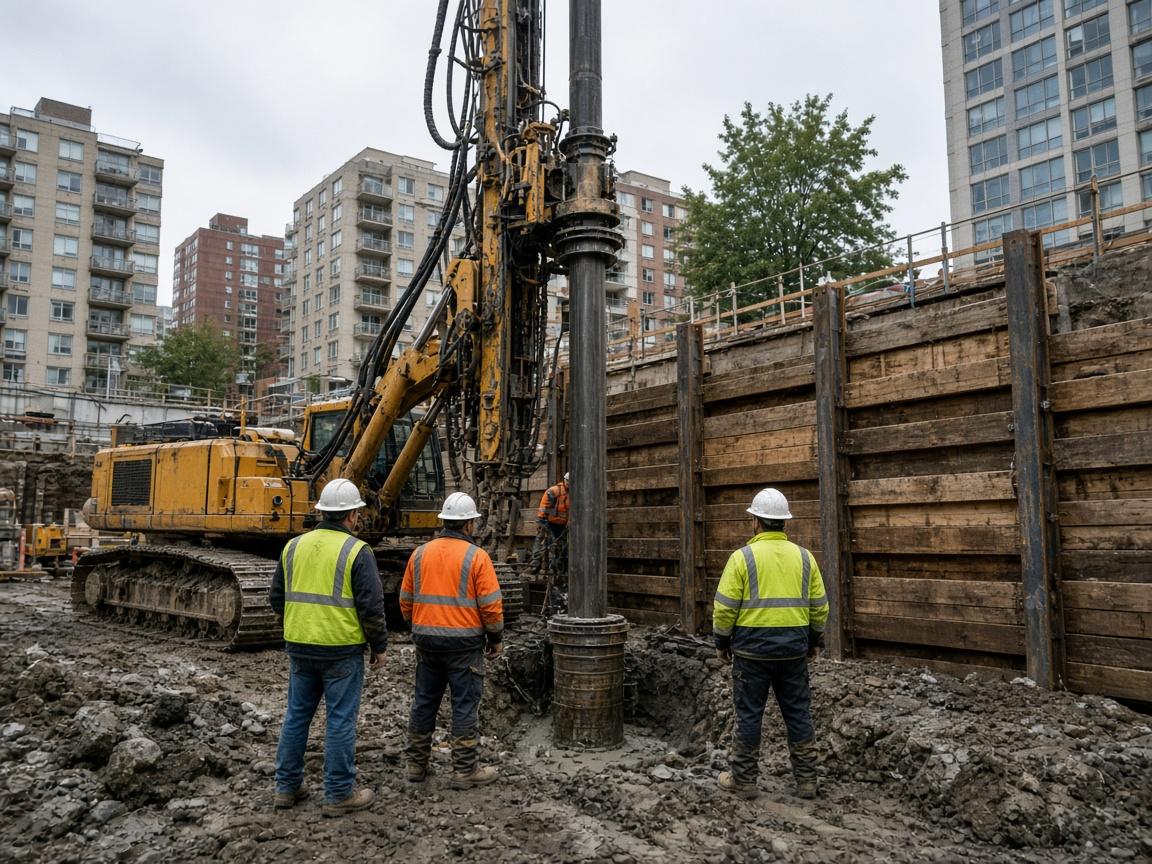
Soldier Pile Retaining Walls in Burnaby
Deep foundation walls for tight sites and extreme grade changes
Soldier pile walls — sometimes called soldier pile and lagging walls or H-pile walls — are a deep-foundation retaining system suited to situations where conventional gravity or cantilever walls are impractical. They're most commonly used on tight urban sites where excavation behind a conventional wall base is impossible, on sites with very high groundwater where a permeable wall is needed, and for temporary shoring of excavations.
The structural principle: large H-section steel piles are drilled or driven into the ground at regular intervals (typically 1.5–3.0m spacing). Between the piles, horizontal elements called "lagging" — usually timber planks, shotcrete panels, or precast concrete planks — span from pile to pile to retain the soil face. The piles extend below the excavation level to develop passive resistance in the soil below, which prevents the wall from kicking out at the base.
Soldier pile walls are specialty work requiring specific equipment and engineering. We install them on commercial and residential projects in Burnaby and across the Lower Mainland.
How Soldier Pile Walls Are Installed
The sequence for a soldier pile and lagging wall is: layout, pile installation, excavation in lifts, and lagging installation as excavation proceeds.
Pile installation uses either an excavator-mounted drill (auger) or a hydraulic pile driver. Drilled piles are more common in urban settings because they're quieter and can be installed with better dimensional control. For each pile location, a hole is drilled to the specified depth (typically 1–2x the retained height below the bottom of excavation), the H-pile is lowered in, and the annular space is grouted with lean concrete.
After all piles are installed, excavation begins. It proceeds in lifts — typically 0.5–1.0m at a time — and lagging is installed after each lift before the next lift of excavation begins. For timber lagging, planks are cut to fit between the pile flanges and wedged into place. For shotcrete lagging, wire mesh is fixed to the pile faces and shotcrete is applied to the required thickness.
Drainage through a soldier pile wall requires careful detailing. Timber lagging is naturally porous to some degree; for tighter systems, weep holes through the lagging and a drainage layer behind the lagging are installed.
When to Use Soldier Pile Walls
Soldier pile walls are the right choice in several specific scenarios.
Very tight site constraints: when there's insufficient room to excavate the slope required for a conventional gravity or cantilever wall, a soldier pile wall can be installed at the property line with minimal offset. This is common in urban infill development in Burnaby where buildings are close together.
Temporary construction shoring: soldier pile and lagging walls are the most common temporary shoring system for construction excavations. They're economical for temporary use and can be removed after the permanent structure is in place.
Variable soil conditions with hard obstructions: H-piles can be driven through or past obstructions that would stop a conventional footing installation.
Sites with high groundwater: the permeable nature of timber lagging makes soldier pile walls useful where groundwater pressure would overwhelm a solid concrete wall. The water moves through the lagging rather than building up behind it.
Permanent vs. Temporary Soldier Pile Walls
Soldier pile walls can be either temporary or permanent, with different design standards for each.
Temporary walls (shoring) are typically designed for 1–2 years of service life and use slightly relaxed design factors. Piles may be removable H-piles that can be extracted after the permanent structure is built. Timber lagging is suitable for temporary walls — it's economical and easily installed.
Permanent soldier pile walls require a higher design standard — the piles are designed for the full service life with appropriate corrosion allowances, and the lagging must be durable in soil contact conditions. For permanent applications, concrete or shotcrete lagging is preferred over timber, and the piles are typically galvanized or encased in concrete below grade.
We provide permanent soldier pile retaining walls for commercial site development and residential retaining applications where the site geometry demands this approach.
Frequently Asked Questions
Are soldier pile walls more expensive than conventional retaining walls?
Yes, typically significantly more expensive on a per-linear-metre basis. They require specialty equipment (pile drilling rig), engineered H-pile sections, and more complex construction sequencing. They're used when site conditions require them, not because they're economical.
How close to a property line can a soldier pile wall be installed?
Piles can be installed very close to property lines — sometimes at the line itself if the pile extends vertically. This is one of their key advantages over conventional walls.
Can soldier pile walls be used for residential retaining?
Yes, though they're rarely the first choice for residential work given their cost. In Burnaby's dense neighbourhoods, a homeowner trying to retain a significant grade change on a lot boundary close to a neighbour's structure might need a soldier pile wall where a conventional wall isn't feasible.
Need a soldier pile retaining wall in Burnaby or the Lower Mainland? These are specialty projects and we handle them — call to discuss your situation.
Burnaby Retaining Wall Experts — serving Burnaby and the Lower Mainland.
Get a Free Quote
- Licensed & Insured
- BC Certified Contractors
- Local Burnaby Team
- Free On-Site Quotes