Retaining Wall Drainage Systems in Burnaby
Proper drainage is what makes walls last — we get it right
Drainage is the reason most retaining walls fail. Say that slowly: most retaining wall failures are drainage failures. Not material failures. Not design failures. Not installation failures. Drainage failures.
Hydrostatic pressure — the pressure that water exerts as it builds up behind an impermeable barrier — increases rapidly with depth. A wall with no drainage can have thousands of kilograms of water pressure pushing against it after a heavy rain event. The best-engineered wall will eventually yield to that load if the drainage system is absent or blocked.
In Burnaby's climate — 1,500–2,000mm of annual rainfall, concentrated in the October-to-March wet season — drainage is not optional. It's the most important part of any retaining wall system. We install drainage systems as a standard component of every wall we build, and we fix drainage failures on existing walls that were built without it or that have had their drainage systems fail over time.
How Retaining Wall Drainage Systems Work
The standard drainage system behind a retaining wall consists of three components that work together.
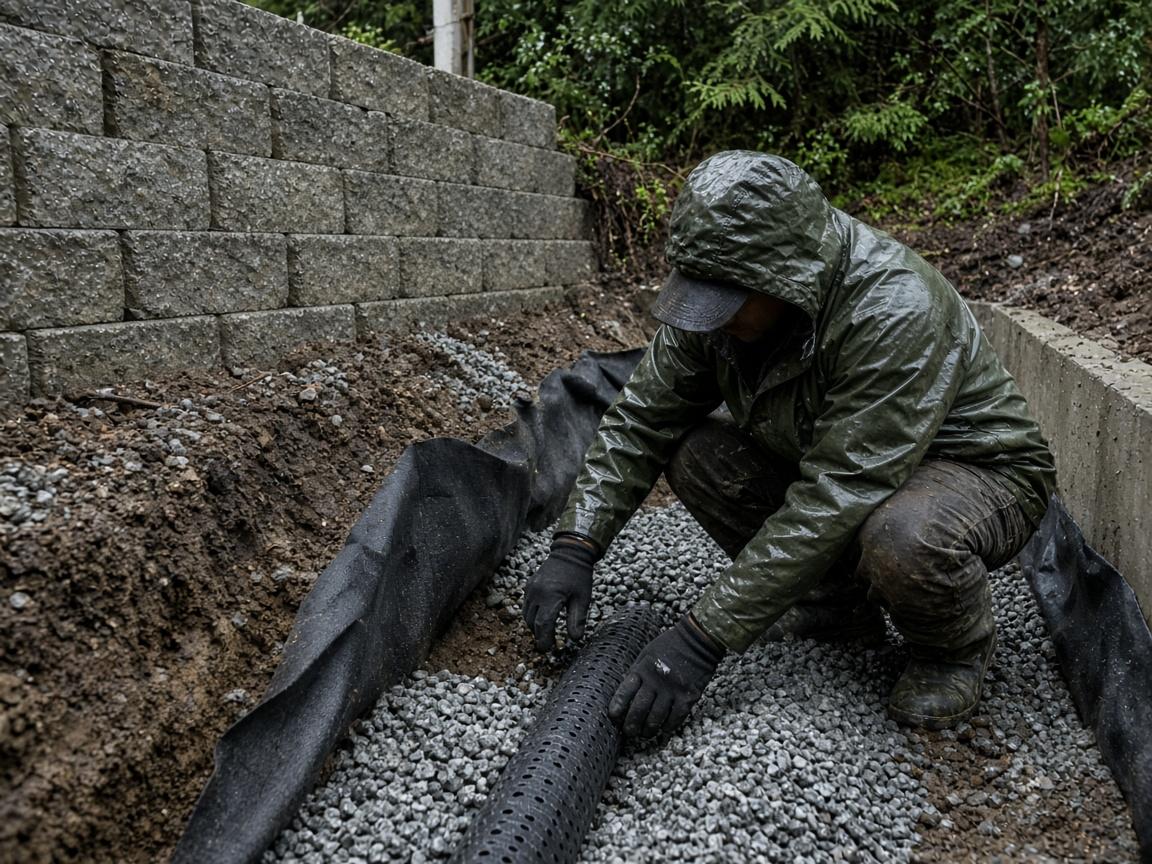
Drainage aggregate: crushed clear stone (no fines) placed immediately behind the wall face from the footing level to within 300mm of finished grade. Clear crush (19mm or 25mm crushed stone that is stone-on-stone with no sand or fines) has a high permeability rate — it allows water to move through it rapidly rather than holding it. This layer intercepts water that percolates down through the backfill and routes it down to the collection pipe.
Perforated drainage pipe: a 100mm diameter perforated flexible or rigid pipe laid at the base of the drainage aggregate, along the toe of the wall. The pipe is wrapped in a geotextile filter sock to prevent fines from entering and blocking the perforations. Water collected by the drainage aggregate flows into the pipe and is carried to a discharge point — typically a low point on the property, a storm drain connection, or a daylight outlet at the wall face.
Weep holes: openings through the wall face at regular intervals (typically every 1.5–2.0m horizontally) at the base of the wall. Weep holes provide secondary drainage relief — they allow water that bypasses the drainage aggregate and pipe to escape through the wall face rather than building up behind it. For mortared walls, weep holes are formed deliberately. For block walls, they're created by omitting mortar from one vertical joint per bay.
Geotextile filter fabric: a permeable fabric placed between the drainage aggregate and the native backfill. This allows water to pass from the backfill into the aggregate but prevents fine soil particles from migrating into the drainage layer and blocking it over time.
Diagnosing Drainage Failures in Existing Walls
When we're called to assess a leaning, cracking, or bowing retaining wall, the first question is always: what happened to the drainage?
The most telling clues are visual. A wall with working drainage should show no signs of water seepage through the face between rain events. Weep holes (if present) should flow during or immediately after rain but stop within hours of the rain ending. A wall with constant face seepage, white mineral deposits (efflorescence) on the face, or no visible drainage outlet is a wall with a compromised drainage system.
Excavating behind the wall is often the only definitive way to assess the drainage layer condition. We look for blocked or absent drain pipe, drainage aggregate that has silted up with fines (often because the geotextile wasn't installed or has failed), and direct evidence of water pooling at the footing level.
Common failure modes: the drainage pipe outlet has been buried or blocked by landscaping; the geotextile filter sock on the pipe has degraded and the pipe is full of silt; the drainage aggregate was not specified clearly and the contractor used crushed stone with fines that has stopped draining; and — in many older walls — no drainage was installed at all.
Drainage Remediation Options
The ideal fix for poor or absent drainage is to excavate behind the wall, install a complete drainage system, and backfill. This is disruptive but permanent.
When full excavation is impractical (for example, due to a structure or paving above the wall), alternatives include:
Supplemental weep holes: coring through the wall face with a diamond core bit to create additional drainage relief. This doesn't fix the drainage aggregate problem but reduces the buildup of hydrostatic pressure by giving water a way out.
Surface drainage correction: redirecting downspouts, surface channels, and grading to prevent water from reaching the area behind the wall. This doesn't fix the wall drainage but reduces the volume of water that the (failed) drainage system must handle.
French drain at the top of the wall: an interceptor trench with perforated pipe at the top of the slope, uphill from the wall, can capture much of the water before it reaches the wall. Again, this is a partial solution but can dramatically reduce hydrostatic pressure.
We'll assess what's practical for your specific wall and recommend the option that actually solves the problem — not just the cheapest option that delays the next failure.
Frequently Asked Questions
My retaining wall doesn't have any weep holes — is that a problem?
It depends on whether there's drainage aggregate and pipe behind the wall. Weep holes are secondary drainage — the primary system is the aggregate and pipe. If both are absent (common in many older residential walls), yes, you likely have a drainage problem waiting to manifest.
How much does it cost to add drainage to an existing retaining wall?
Coring weep holes is typically $1,000–$3,000 depending on wall length and access. Full drainage remediation (excavating behind and installing proper drainage) varies widely with wall size and site access — get a site-specific quote.
Water is coming through the face of my retaining wall — what does that mean?
Water coming through the face indicates the drainage system behind the wall is saturated — there's more water behind the wall than the drainage can handle. This is either a drainage failure (blocked pipe) or an absent drainage system. It needs attention, especially before winter.
Concerned about drainage behind your retaining wall? We diagnose and fix retaining wall drainage problems across Burnaby. Call for an assessment.
Burnaby Retaining Wall Experts — serving Burnaby and the Lower Mainland.
Get a Free Quote
- Licensed & Insured
- BC Certified Contractors
- Local Burnaby Team
- Free On-Site Quotes