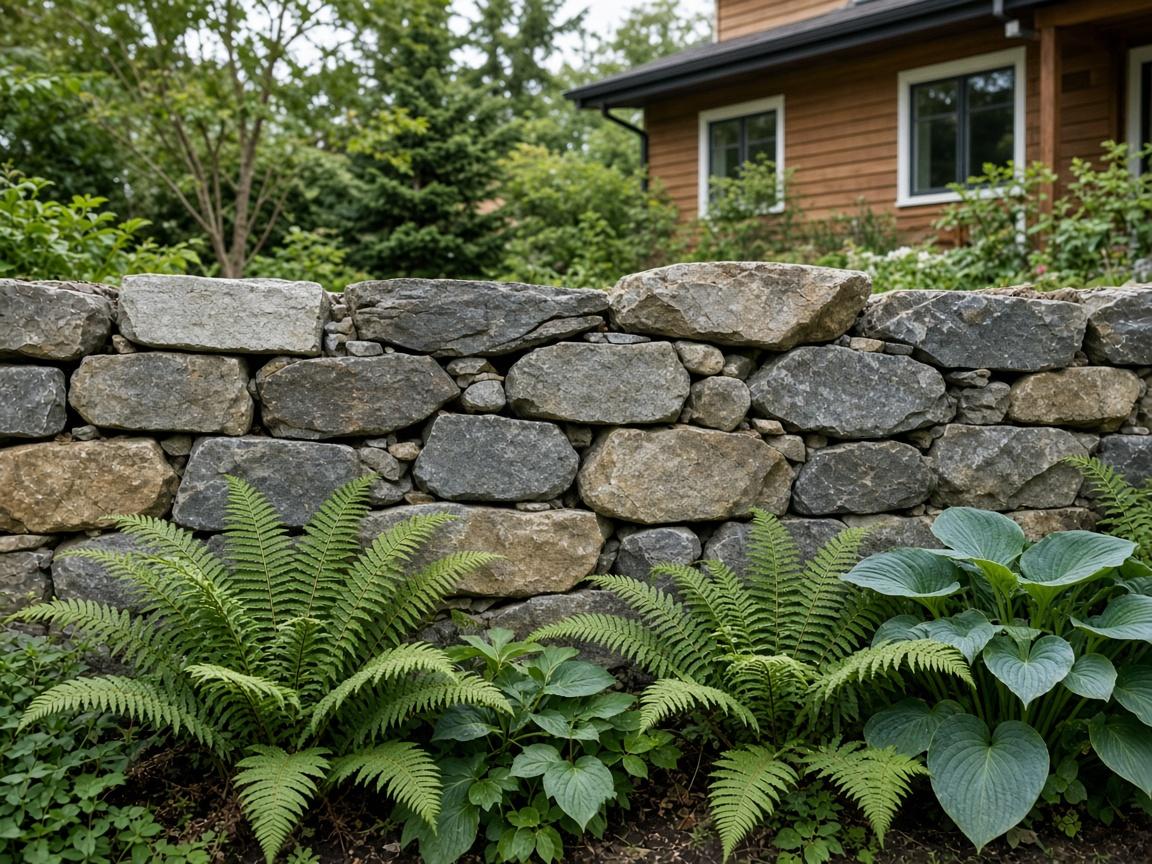
Natural Stone Retaining Walls in Burnaby
Fieldstone, river rock, and granite walls that age beautifully
Natural stone retaining walls are, in our view, the most beautiful of all retaining wall types. There's nothing manufactured that quite matches the visual warmth of fieldstone, the texture of quarried granite, or the organic rhythm of river rock stacked by someone who knows what they're doing.
They're also among the most durable. A dry-laid natural stone wall built on a proper foundation, with adequate drainage, in a climate like Burnaby's can genuinely last a century or more. The same cannot be said for most manufactured products.
That said, natural stone walls require skill that not every contractor has. The stones are irregular, heavy, and need to be selected and placed in a way that creates structural interlock and a sound bond. A poorly built stone wall looks wrong and fails faster than an equivalent block wall. We build stone retaining walls the right way — starting with drainage and a proper footing, selecting stones for size and shape, and placing them to create real structural integrity.
Dry-Stack vs. Mortared Stone Walls
The two approaches to natural stone retaining walls have distinct structural characteristics and aesthetic results.
Dry-laid (dry-stack) walls are built without mortar. The stones are carefully selected and placed to interlock, and the wall's stability comes from the mass of the stone and the friction between irregular surfaces. Dry-stack walls are self-draining — water moves freely through the joints — which is a significant advantage in BC's wet climate. They're also more forgiving of ground movement; individual stones can shift slightly without causing structural failure. The aesthetic is more rustic and naturalistic.
Mortared stone walls look more formal and give you better control over the finished surface. The mortar fills joints and creates a more uniform face. However, mortared walls must have weep holes at the base and adequate drainage behind them, because water cannot escape through the joints. If the drainage fails, hydrostatic pressure builds behind the wall and the mortar joints crack. Mortared walls also require a concrete footing rather than a compacted granular base.
For most residential retaining applications in Burnaby, dry-stack is our recommendation. It handles BC's rainfall better, requires less ongoing maintenance, and looks excellent in the Pacific Northwest landscape context.
Stone Types We Work With
The Lower Mainland and BC interior have access to several excellent stone types for retaining wall construction.
Fieldstone (also called rubble stone) is gathered or quarried stone in irregular shapes and sizes. It requires the most skill to place well, but a beautifully laid fieldstone wall has an authenticity that no manufactured product can replicate. Local basalt and granite fieldstone from the Fraser Valley are excellent wall materials.
Quarried granite is more dimensionally consistent than fieldstone. Granite is extremely durable, holds up well to BC moisture, and is available in various sizes from small landscape stone up to large wall blocks. Split-face granite has a naturally textured surface that looks excellent in retaining wall applications.
Limestone and sandstone are softer stones and more prone to weathering in BC's acid rainfall environment over long periods. We generally don't recommend them for structural retaining walls.
River rock (rounded cobbles) can be used for low retaining walls and in gabion-style applications, but rounded stones have poor interlock and are not suitable for freestanding dry-stack walls over about 600mm.
We'll advise on stone type during the site assessment, factoring in your aesthetic preferences, budget, and what's locally available.
Building a Natural Stone Retaining Wall
Good stone work is slower than block work. There's no shortcut to sorting and selecting stones, and no fast way to lay them well. Here's what the process looks like.
Site preparation and drainage installation happen first, same as any retaining wall. Excavation to the footing depth, compacted granular base (for dry-stack) or concrete footing (for mortared work), and the drainage aggregate and pipe placed at the back of the excavation.
Stone selection and sorting is the step that separates a good stone mason from an average one. Before a stone goes on the wall, we're looking at its shape, its largest flat face, its thickness, and how it will bond with the stones below and beside it. Large, flat-bottomed stones go at the base. Stones with irregular shapes are sorted so they'll fill gaps left by their neighbours.
Placement is done with a backward batter — the wall leans slightly into the slope. We use a batter board and string line to maintain a consistent lean. Typical batter for a dry-stack stone wall is 25–50mm per metre of height.
Each stone course bridges the joints in the course below — similar to brick bond. Long "tie stones" that extend well into the wall provide cross-wall stability. Chinking (small stone fragments) fills voids in the wall interior, adding mass and preventing the wall from shifting.
Cap stones are the finishing detail. Flat, wide stones at the top of the wall protect the courses below from direct rain impact and create a finished edge.
Frequently Asked Questions
How high can a natural stone retaining wall be built without a permit?
In Burnaby, the 1.2m permit threshold applies to stone walls the same as any other retaining wall material. A dry-stack stone wall over 1.2m needs a permit and may require engineering.
Do natural stone walls need drainage?
Dry-stack walls are self-draining through the joints, which is one of their advantages. Mortared stone walls require drainage behind them just like any other mortared or concrete wall. We install drainage aggregate and perforated pipe behind all mortared stone walls as a standard measure.
Can you source stone locally in BC?
Yes. There are several quarries and landscape supply yards in the Lower Mainland and Fraser Valley that carry good wall stone. We can source material directly or advise on where to buy if you prefer to supply your own stone.
How do you repair a natural stone wall that's falling apart?
The repair approach depends on whether the wall was originally dry-stack or mortared, and what caused the failure. Dry-stack walls with displaced stones can often be rebuilt section by section. Walls that are leaning due to drainage failure need the drainage addressed first, then the stones re-laid. We assess before we recommend.
Interested in a natural stone retaining wall in Burnaby? We build beautiful, lasting stone walls — call for a free site assessment.
Burnaby Retaining Wall Experts — serving Burnaby and the Lower Mainland.
Get a Free Quote
- Licensed & Insured
- BC Certified Contractors
- Local Burnaby Team
- Free On-Site Quotes