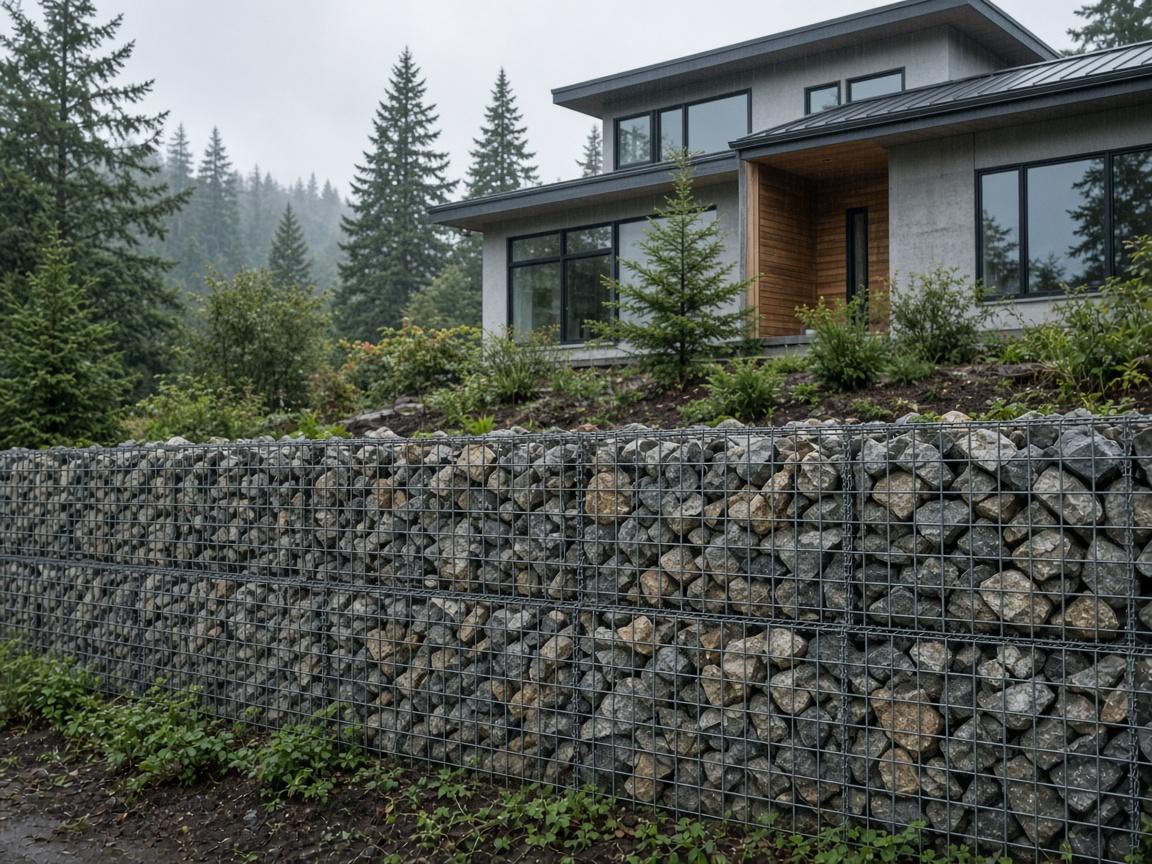
Gabion Retaining Walls in Burnaby
Wire basket and rock walls — strong, permeable, and modern
Gabion retaining walls are built from rectangular wire mesh baskets filled with rock. They're one of the oldest retaining structures in the world — the Romans used wickerwork basket walls filled with earth — and the modern welded wire mesh version is among the most naturally draining, environmentally appropriate retaining systems available.
In BC's wet climate, gabion walls have a compelling advantage: they're completely permeable. There's no drainage to install behind them, no risk of hydrostatic pressure buildup, and no weep holes to maintain. Water moves freely through the rock fill and out the face. This makes gabion walls particularly suitable for locations with high water tables, spring seeps, or heavy seasonal runoff.
The aesthetic is industrial-natural — more suited to contemporary landscapes, rural properties, and naturalized settings than to traditional residential streetscapes. Done well, a gabion wall can look striking. It's a specific aesthetic choice, and we'll tell you honestly if it suits your setting.
How Gabion Walls Are Constructed
Modern gabion baskets are made from heavy-gauge galvanized welded wire mesh, typically 3.0–4.0mm wire diameter with a 75–100mm mesh opening. The baskets come in standard sizes: 1m x 1m x 1m (or 2m long), and are assembled on-site from flat-packed panels.
The baskets are placed on a prepared granular base — same preparation as other wall types — and the base row is checked for level and alignment. Baskets are tied together at their edges with wire ties or C-clips to create a continuous monolithic face.
Rock fill is placed manually or with equipment. The choice of rock matters: angular crushed rock fills more densely and locks together better than rounded material. Rock size should be larger than the mesh opening (so nothing falls through) but not so large that filling is difficult — typically 100–200mm rock for standard baskets.
As each basket is filled, the lid is attached and the next row of baskets is placed on top. The visual face of the wall can be a selectively placed "face stone" (larger, more attractive pieces at the front, with bulk fill behind) to improve the aesthetic.
No drainage is required behind a standard gabion wall. The wall itself is the drainage medium.
Applications Where Gabion Walls Work Best
Gabion walls are excellent for:
Stream bank and creek bank stabilization, where the wall will be periodically submerged. Gabion walls hold up well to flow conditions that would undermine other wall types, and they allow riparian vegetation to root through the rock fill over time.
Rural and agricultural slope retention, where aesthetics are less critical and the economics of large, simple walls favour gabion construction. A gabion wall on a farm access road can be built quickly with locally available rock.
Contemporary residential and commercial landscapes where the industrial aesthetic is embraced. A gabion wall with a wood or steel cap detail in a modern garden setting can look genuinely impressive.
Erosion control on steep slopes with active seepage, where conventional wall drainage systems would be overwhelmed.
They're less suited for traditional residential front yards, areas where the aesthetic needs to match conventional masonry, very tall walls with significant surcharge loads (where geogrid-reinforced or concrete systems are more appropriate), and any situation where the wire mesh will be subject to vandalism or vehicle impact.
Gabion Basket Materials and Durability
The durability of a gabion wall depends almost entirely on the durability of the wire mesh baskets. Standard galvanized wire has a reasonable service life in most environments — typically 25–50 years before significant corrosion becomes an issue. PVC-coated galvanized wire (common in geotechnical applications) extends this to 50+ years and is recommended in coastal or chemically aggressive environments.
The rock fill, assuming angular crushed stone or durable granite/basalt, will last indefinitely. The only degradation of the wall system itself comes from wire corrosion or mechanical damage to the mesh.
When gabion baskets eventually corrode significantly, individual baskets can be lined with geotextile, filled with concrete, or replaced. A gabion wall rarely fails catastrophically — it degrades gradually, giving plenty of time to plan for replacement or rehabilitation.
Frequently Asked Questions
Do gabion walls need drainage?
No — this is one of their primary advantages. Gabion walls are self-draining. Water moves freely through the rock fill. No perforated pipe, drainage aggregate, or weep holes are required.
What rock is used to fill gabion walls?
Crushed angular rock — typically granite or basalt — in the 100–200mm size range. The rock should be angular (not round) for good interlock, hard (not limestone that will break down), and locally available. We source rock from quarries in the Lower Mainland.
Are gabion walls expensive?
It depends on the scale. The wire baskets themselves are not extremely expensive, but rock delivery and placement labour can add up. For large walls, gabion can be cost-competitive with block. For small residential walls, the cost per linear metre isn't dramatically cheaper than concrete block, and the aesthetic trade-off is a real consideration.
Interested in a gabion retaining wall in Burnaby? We assess your site and give you a clear comparison of options. Call for a free quote.
Burnaby Retaining Wall Experts — serving Burnaby and the Lower Mainland.
Get a Free Quote
- Licensed & Insured
- BC Certified Contractors
- Local Burnaby Team
- Free On-Site Quotes